Moving the mouse over the text of the Production Code brings about options that will be spelled out in the top frame (when there is spelled out options that can be exercised). Clicking the white-on-red “[R]” or “[E]” will make the screen display additional material. Don’t worry about not being able to read more of the Production Code text that you already have on the screen — it’s not going away, but simply remaining in the wide left-side while the new materials is retrieved and placed in the right-side column. You will always have two columns of text when you select “[R]” or “[E].”
Don’t want to drag your mouse all the way to the top of the window? You don’t have to. The red boxes with yellow lettering at the left edge of the screen serve the same function as the white “[R]” and “[E]” links at the top.
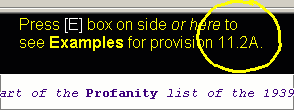
After selecting to see “Reasons” or “Examples,” the screen will have a dual-column design: the left column will show the Production Code, whereas the right column will show either: (a) examples for the currently-selected section of the Production Code, or (b) text of “Reasons Supporting the Code”. The determinant of whether you see (a) or (b) is whether your mouse clicked a “[R]” or “[E]” button.
Do you notice how this image highlights section 11.2A?
If you don’t want the examples or reasons for 11.2A but rather for another section, just move the mouse. You’ll get new options that are yours from clicking “[R]” or “[E].” As you move the mouse down the Production Code, watch the options change! Sometimes they change with every paragraph!. When you find the passage you are salivating about, it’s time for “[R]” or “[E].”


The “[R]” and “[E]” buttons are animated to (intermittently) state their functions (and direct your attention to the buttons).
 |
 |
Sometimes you will see links for pictures, sound clips or even full-motion video. When you do, realize that the pictures will open in a new pop-up window, and that the declaration “Sound” usually opens a new pop-up window on which you can choose the sound format for playback. (The exception to the rule about pop-ups is where the choice of WMA or MP3 formats is given right in the “Examples” column.) The guiding rule about this web site is that you never lose presence of a text unless you close a window, use the “back” key of the browser, select the single-column mode (through the header frame link), or switch from “Reasons” and “Examples” (by using the “[R]” or “[E]” buttons while already in multi-column mode.)
Note: You should consider deactivating pop-up blocking if you have it, while on this site.
Use the Text TipsJust by placing your mouse over a year, you’ll see something like this:
Wherever you see a year number given in a different type face and character spacing,
you may place the mouse over the year to get additional information about how the release
date of that particular film fits into the timeframe of the MPPDA’s authority. (In a very few cases, a word is formatted this way, and in these cases it is possible to place the mouse over the text to get additional text.) |
This web site lets you read:
This site has outside links to the complete full texts of the Production Codes of
|
The Production Code of the Motion Picture
Industry
|
How the Code Came AboutThe Production Code came into being because the owners of the major Hollywood movie studios sought to stave off the threat of a national government-run censorship operation. They also wanted to assure concerned civic leaders throughout the United States that Hollywood would deliver only wholesome movies and thus that there was no further editing to be done by the state and local censorship boards that had sprung up during the decade preceding the Code. The Studio Relations Committee was organized in 1930 by the already-extant organization the Motion Picture Producers and Distributors of America (MPPDA) and given the responsible for the administration of industry self-censorship. The Studio Relations Committee was reconstituted as the Production Code Administration in 1934, after which it was more effective. (Prior to 1930, the MPPDA had circulated a list of 36 subjects called the “Don’ts and Be Carefuls” (1927). The MPPDA had formed in 1922 to reassure America that Hollywood did not condone immorality in the wake of lifestyle scandals then in newspaper headlines.) The Production Code was adopted March 31, 1930, although it would be modified over the years. (Examples are cited elsewhere within this web site.) |
Why the name “Hays Code”?The name “Hays Office” has long been synonymous with Hollywood’s self-censorship body, yet its namesake ceased to be involved in its daily operations prior to the period of its most-remembered conflicts with filmmakers. Will H. Hays had indeed been the first president of the MPPDA (in 1922). He had been installed as leader when the studio heads sought a man whose background in federal government would reassure the nation that Hollywood films would not corrupt the citizenry. During the period that the Production Code was in existence, its enforcement was the responsibility of Jason Joy (1930-32), James Wingate (1932-34), Joseph I. Breen (chief censor the longest: 1934-54), and Geoffrey M. Shurlock (1954-68). Stephen Jackson filled in for Breen for several months in 1948. Eric Johnston replaced Will H. Hays as head administrator in 1945 and remained until his death in 1963. Jack Valenti became the face of the organization in 1966. Each of these three men was more an ambassador, lobbyist and salesman for the movie industry than a shaper of content. (The same year Johnston started, the organization changed its name to the Motion Picture Association of America (MPAA).) (Readers noticing the similarity between the name in “Hays Office” and the surname of the author of this web site, should examine the disparity in spelling. Beyond the different spelling, the author of this web site has no known relationship to any person connected with the MPPDA/MPAA.) |
Ever notice that films of the 1930s and 40s
In noticing these, you’ve seen instances where the Production Code Administration had their way against the wishes of filmmakers. The Production Code Administration scuttled, weakened or diluted numerous scenes proposed by writers and directors of Hollywood films from 1934 to 1968. (When you look at the Production Code itself (frame at left) and click on the graphics on the outer edge of the browser frame, you will open within a sub-frame various lists of examples: scenes that skirted the Production Code, scenes that could not be filmed under the Production Code, scenes that were changed because of the Production Code, or (not often) scenes which reached movie screens despite the existence of Production Code. |
|
|
Notes about re-editings of the Production Code The version of the Production Code originally adopted by the Motion Picture Producers & Distributors of America on March 31, 1930, is in its substance the same as the rewritten version dated June 13, 1934. Revisions after the latter date brought about changes, additions and deletions concerning the content allowed in movies, yet the revision of the 1930 version done in 1934 was merely a case of revising to improve the readability. This web site does not provide the text of the 1930 version because the 1934 version is substantially the same. The table below provides one example of how a passage was reworded from its 1930 version for its 1934 incarnation. Those interested in reading the 1930 version (not reproduced on this site) and comparing it to the 1934 and later versions (which are on this site) may do so by bringing up the 1930 version at artsreformation.com (complete) and gmu.edu (without “Reasons” section).
In 1956, the Production Code was fully rewritten yet again. It became much shorter. This shorter, leaner version of the Code can be read online at Google Books (where it appears with a footnote about a 1961 change, lacks section XI and seems to be reproduced from a source which left off the entire “Reasons” section). (Although the page you are currently reading does not endeavor to indicate every cut made for the 1956 version of the Production Code, notations are made denoting significant differences between the pre-1956 and post-1956 editions. Readers of this page should not assume that they will learn of every change, but can observe where allowances were permitted to filmmakers regarding subject matter previously denied them.) One more thorough rewrite of the Production Code occurred, this one dated September 20, 1966. The text is offered as a supplement on this Production Code web site. The passages restricting the content of the movies became the leanest of any version of the Code, a small fraction of the size of the earlier ones. The 1966 version has just ten items of one to three sentences each. Even with its sections on declaration of principles, permissible advertising, permissible titles, and administrative matters, this version of the Code is puny. For the Motion Picture Association of America, its efforts to update the Code for the late 1960s proved untenable; in just a couple of years, the Motion Picture Association introduced the modern ratings system (“G” “R”, “X”, etc.), ridding the industry of the old idea of the Code entirely. Readers of this web page should be aware that tables such as the one above do appear to indicate passages of the Code that were added or removed during the period of 1934 to 1955. This page endeavors to show every passage that was part of the Code from 1934 to 1955. For that reason, the Code is occasionally interrupted to show two (or more) versions of the same passage, along with date information alerting the reader as to which years the particular passage was in effect. Readers who find this confusing may want to confine their reading of tables to only the top white-background cell in each table, as that will be earliest version. Comments by the creator of this web site are in a different type font, italicized and indented. Note to readers about additions to the Code are indicated in notes formatted as this one is; likewise, remarks about passages which were moved from one section to another, are made in notes of this kind. However, not every deletion is indicated. Where the Code ceased to include an item, it typically was not owing the subject ceasing to be objectionable (in the view of the Production Code Administration) but due to the subject remaining covered by a broad category that retained enforceability.
|
A Word About Changes in Wording
|
LAUREL & HARDY VS. THE CENSORS AYN RAND VS. HOLLYWOOD SELF-CENSORSHIP TWO ARTICLES ON FILMS DEALING WITH ABORTION:
(Each article will open in a new window.)
This is not all, Folks! Links provided within the “examples” frames launch illustrated pages on over two dozen subjects. Some of these two-dozen-plus separate windows have audio and motion-video available. Almost all have still images reproduced from the actual movies under discussion. Among the subjects illustrated are:
|

All new content on this web site © 2000-2009 David P. Hayes